Voices of Silicon Valley:
Using Heritage Discourse
to Counteract Placelessness & Build Belonging
NEH Grant Termination
California History Center has joined the ranks of those organizations and institutions who have recently lost federal funding due to changing priorities. On April 2, 2025, we received a historic letter from National Endowment for the Humanities:
“Your grant no longer effectuates the agency’s needs and priorities and conditions of the Grant Agreement and is subject to termination due to several reasonable causes, as outlined in 2CFR§200.340. NEH has reasonable cause to terminate your grant in light of the fact that the NEH is repurposing its funding allocations in a new direction in furtherance of the President’s agenda. The President’s February 19, 2025 executive order mandates that the NEH eliminate all non-statutorily required activities and functions. See Commencing the Reduction of the Federal Bureaucracy, E.O. 14217 (Feb. 19, 2025). Your grant’s immediate termination is necessary to safeguard the interests of the federal government, including its fiscal priorities. The termination of your grant represents an urgent priority for the administration, and due to exceptional circumstances, adherence to the traditional notification process is not possible. Therefore, the NEH hereby terminates your grant in its entirety effective April 1, 2025.”
Fortunately, much good work has already been done in the past year, and we are researching ways to continue the oral history projects we began through the NEH grant, “Voices of Silicon Valley,” on a smaller or slower scale. We are grateful to the Foothill-De Anza Community College District, De Anza President Omar Torres, and Social Sciences and Humanities Dean Elvin Ramos, for their continual support and encouragement.
Voices of Silicon Valley: Using Heritage Discourse to Counteract Placelessness and Build Belonging is a multi-track project to increase access to the under-utilized, place-based oral histories of the campus’s California History Center (CHC), while also creating new oral histories, digital stories, and an educational walking tour, within a Humanities context and curriculum.
Located in the Silicon Valley, a region at the nexus of the agriculture and technology industries in Santa Clara County, on unceded land that is culturally and materially enriched by vibrant immigrant communities, the College is eager to undertake the work of crafting historical inquiry and narratives that include marginalized communities and better reflect and promote the authentic identity of Silicon Valley.
"By gathering and sharing the “raw materials of history,” the multi-track effort highlights important stories about Silicon Valley" says Lori Clinchard, project director and Humanities chair. Clinchard, who is faculty coordinator of the California History Center, says the effort known as “Voices of Silicon Valley” raises the center's profile as a partner and resource for other campus programs and community organizations.
"With its focus on historically marginalized groups, along with collaborations across campus and the community, the effort closely aligns with De Anza’s mission as a college" says Elvin T. Ramos, dean of Social Sciences and Humanities.
This project is funded through a National Endowment of the Humanities grant, "Voices of Silicon Valley", to California History Center at De Anza College. Any views, findings, conclusions, or recommendations expressed in this web resource do not necessarily represent those of the NEH.
Track 1: Making Archives Accessible
In addition to paper-based collections - including a library of books, manuscripts, research papers, maps, and photos - CHC is also home to a collection of more than 400 audio- and video-taped oral histories, interviews, lectures, discussion panels, and historical talks.
Student interns from the Humanities Mellon Scholars program help catalog, transcribe and digitize these oral histories in the history center’s archives, so they are more accessible for students and researchers.
Tape Digitization and Public Access Status
Completed:
466/556 audio tapes digitized and uploaded to YouTube (unlisted, pending release form review)
157/240 video tapes digitized and uploaded to YouTube (unlisted, pending release form review)
5 audio tapes transcribed, 4 video tapes transcribed
Curation of oral histories and related materials in Jacobson special collection
Ongoing:
Tape digitization and transcription
Presentation of historical information and materials on website pages
Identification of other special collections
Negotiation of release forms for public viewing of historical materials
Thank you to our project contributors:
Clare Aligbe, Student Intern, Transcription
Esteban Harkins, Student Intern, Transcription and Summary
Marcus Jacob, Student Intern, Transcription
Anya Nazarova, Student Employee, Digitization and File Management
Kevin Candra, Student Intern, Digitization
SEE CHC'S ORAL HISTORY RECORDINGS
Track 2: Building Capacity
Lori Clinchard and other faculty members and classified professionals develop workshops on producing oral histories and using them in the classroom. This includes workshops on digital story-telling and gathering stories that accurately represent minority groups and other historically overlooked communities.
Track 3: Raising Community Voices
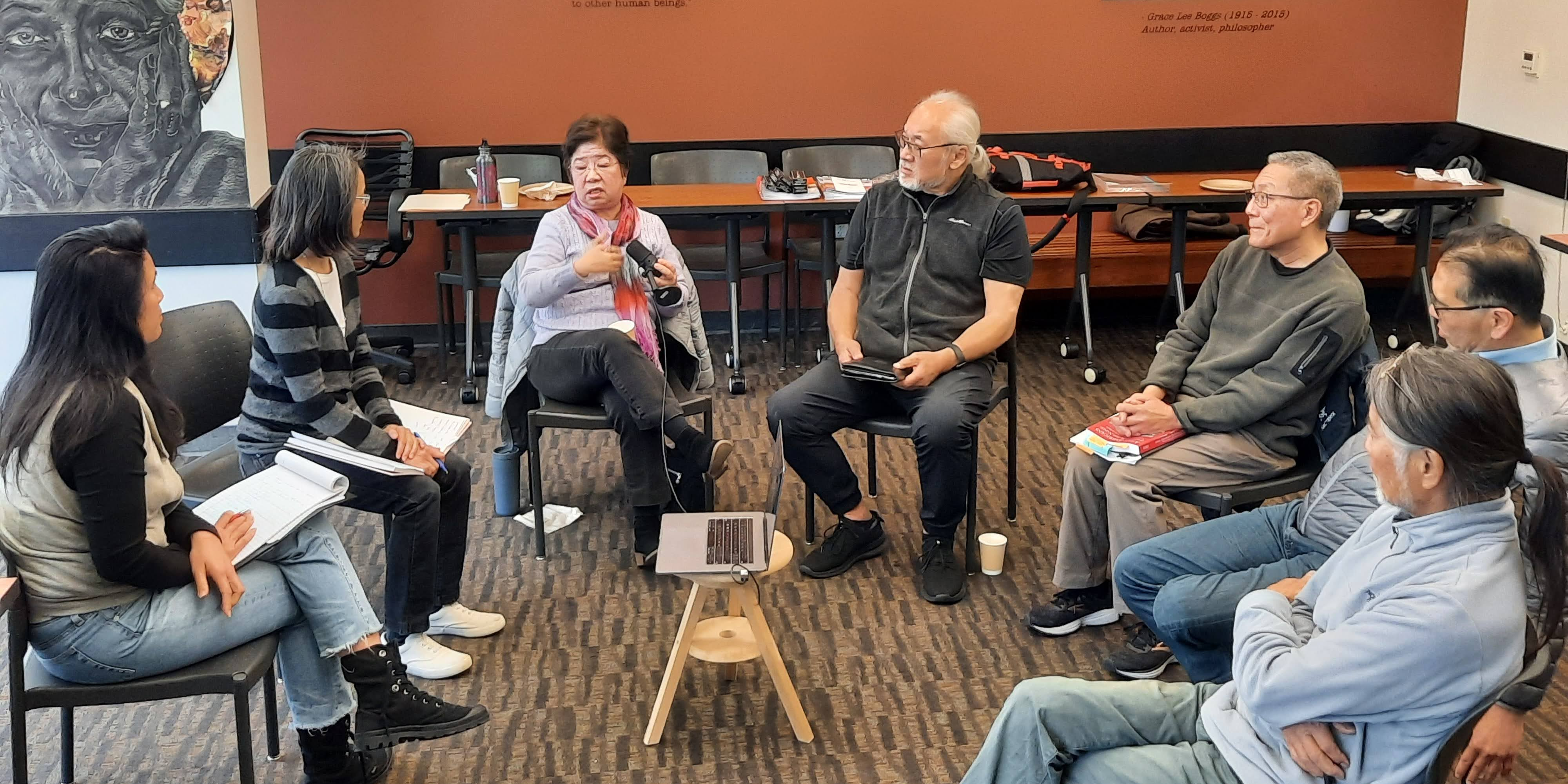
Asian American Story-Telling in the Santa Clara Valley
This project:
- Collects and curates stories of Asian American experiences in the Santa Clara Valley
- Revises the College’s Asian American and Asian Studies (AAAS) website where, along with CHC’s website, these stories are published
- Develops a historical walking tour that builds off the successful augmented reality walking tour and community art project, “The Hidden Histories of San Jose Japantown,” co-directed by the former Director of CHC, current “Places of Belonging” co-coordinator, and community liaison, Tom Izu.
Project co-directors, Mae Lee and Chesa Caparas, situate these stories within an Asian American historical context and utilize an Asian American Studies framework which emphasizes the diversity among Asian American histories are rooted in each communities’ various aspirations and concerns. The stories are woven from two narrative threads: oral histories on the formation and development of AAAS at the College.

The Pride Project
This project:
- Shares stories of decades’ long LGBTQ+ organizing at the College, which has recently resulted in the opening of the Pride Center in Fall of 2022, and the stories of current students who benefit from this space.
Project coordinator and Pride Center Director, Jamie Pelusi, along with trained student interns, conduct a series of oral history interviews chronicling the organizing work around LGBTQ+ issues at the College. In addition, the Pride Center Director begins digital storytelling circles to capture students’ diverse experiences. The discourse around gender and sexual orientation expansiveness is ongoing and rapidly evolving. And our students, who are the creators of this knowledge, are empowered through the opportunity to add to the historical record through telling and sharing their stories.
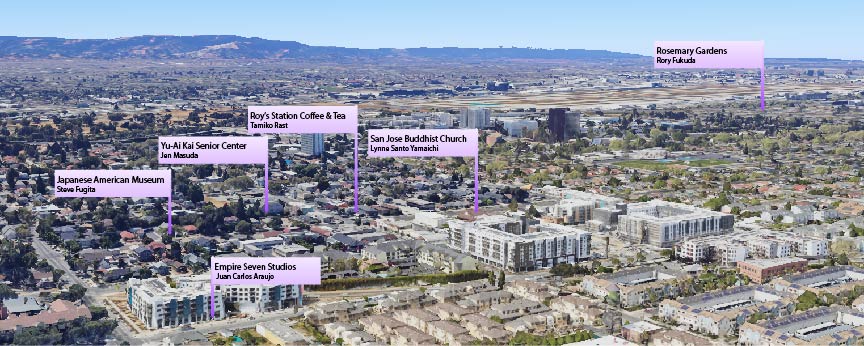
Spaces of Belonging
This project:
- Amplifies the voices of people who have contributed to a sense of belonging for others in their communities.
The oral history topics vary and include interviews with social and cultural workers in the Silicon Valley region who have contributed to building belonging and transforming the lives their community members. This project is an intervention into the way we think about history, moving away from a static perception towards history as a process of intergenerational exchange, social justice, and cultural awareness.
This project has been funded through a National Endowment of the Humanities grant, "Voices of Silicon Valley", to California History Center at De Anza College. Any views, findings, conclusions, or recommendations expressed in this {article, book, exhibition, film, program, database, report, Web resource}, do not necessarily represent those of the NEH.